Using Audit and Remediate together
Using both Audit and Remediate in a workflow
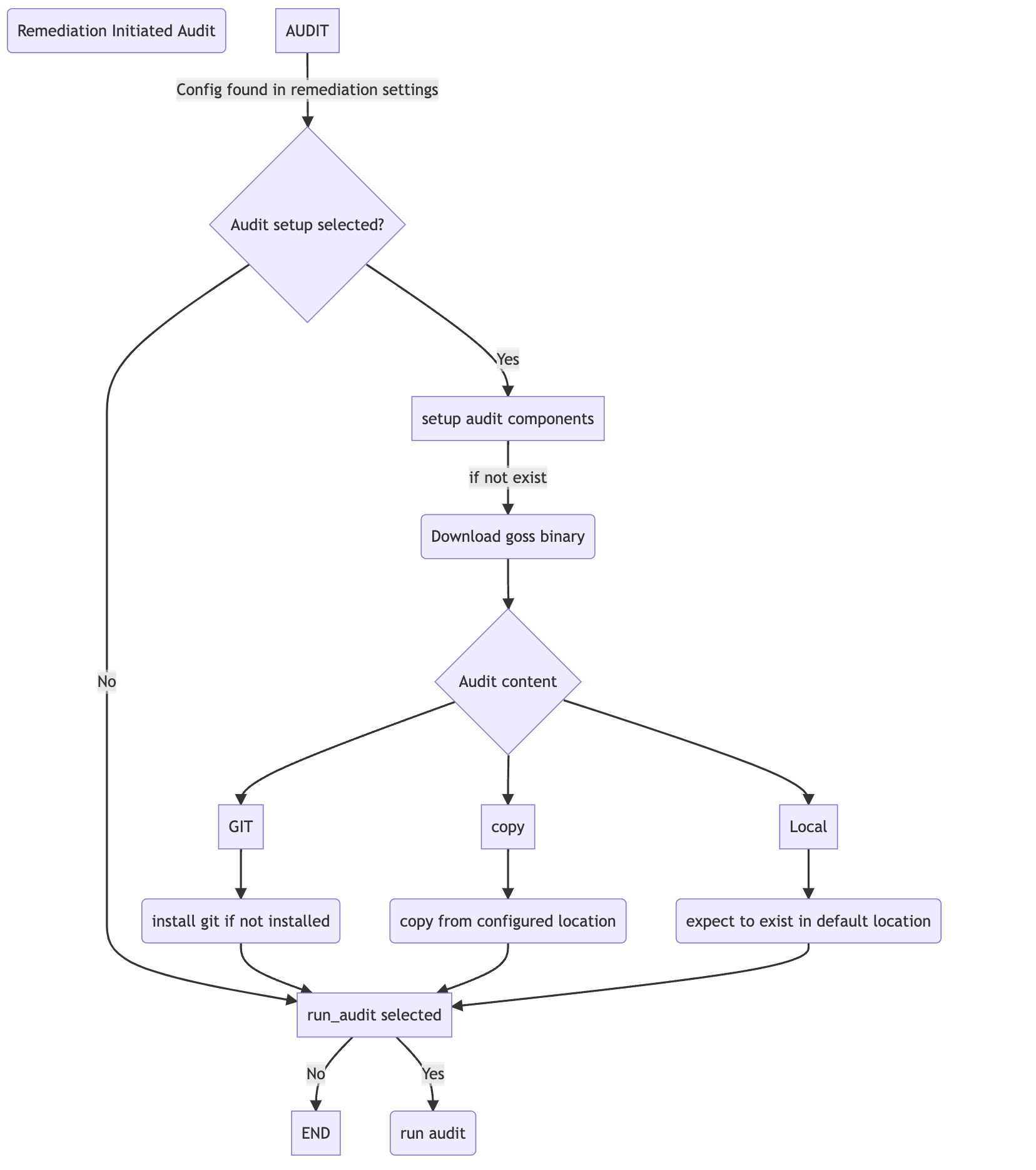
Post Hardening Lockdown Reporting via Ansible_Facts
The templates/etc/ansible/compliance_facts.j2 template records metadata and conditions related to the hardening performed by the Ansible Lockdown role.
Lockdown Ansible_Facts: Creating Custom Compliance Facts
The playbook conditionally creates a custom facts file on managed hosts to document the applied security benchmark and hardening levels.
The excerpt below is from RHEL10-CIS/tasks/main.yml; other roles follow the same pattern with small differences (for example the file mode).
- name: Add ansible file showing Benchmark and levels applied if audit details not present
  when:
    - create_benchmark_facts
    - (post_audit_results is defined) or
      (ansible_local['compliance_facts']['lockdown_audit_details']['audit_summary'] is undefined and post_audit_results is undefined)
  tags:
    - always
    - benchmark
  block:
    - name: Create ansible facts directory if audit facts not present
      ansible.builtin.file:
        path: "{{ ansible_facts_path }}"
        state: directory
        owner: root
        group: root
        mode: 'u=rwx,go=rx'

    - name: Create ansible facts file and levels applied if audit facts not present
      ansible.builtin.template:
        src: etc/ansible/compliance_facts.j2
        dest: "{{ ansible_facts_path }}/compliance_facts.fact"
        owner: root
        group: root
        mode: 'u-x,go=r'
Key Components
Conditional Execution: The block runs only if
create_benchmark_factsistrue(the default), and either a post-remediation audit has produced results or no audit summary has been recorded yet.Tagging: The tasks are tagged with
alwaysandbenchmark, allowing for selective execution during playbook runs.Directory Creation: Ensures the existence of the directory specified by
ansible_facts_path(default/etc/ansible/facts.d), setting appropriate permissions.Facts File Creation: Uses a Jinja2 template to generate the
compliance_facts.factfile in the specified directory.
Custom Facts in Role
Ansible allows the use of custom facts to store host-specific information. These facts are typically stored in files within the /etc/ansible/facts.d
directory on the managed hosts. The facts files can be in JSON or INI format and are loaded automatically during the fact-gathering phase.
The facts are named after the file, so compliance_facts.fact appears as ansible_local.compliance_facts. Ansible reads INI keys in lowercase.
Accessing Custom Facts
Once the custom facts are in place and facts have been gathered, they can be accessed in playbooks using the ansible_local variable.
{{ ansible_local.compliance_facts.lockdown_details.benchmark_release }}
Lockdown Facts Example:
Variables Used
benchmarkandbenchmark_version: The role and benchmark version being applied.CIS
<role>_level_1 | <role>_level_2: Booleans that indicate if level 1 or 2 hardening is enabled.STIG
<role>_cat1 | <role>_cat2 | <role>_cat3: Indicate whether Category I, II, or III controls were enabled during the hardening process.ansible_run_tags: List of tags used during the playbook run to identify scoperun_audit: Boolean to indicate if an audit was performed.audit_log_dir: Path to local audit log directory on the node.post_audit_results: Captured summary results from post-audit steps.fetch_audit_output: Boolean flag to indicate whether audit logs were centralized.audit_output_destination: Destination directory for centralized audit files.
The template snippets below are from RHEL10-CIS and RHEL10-STIG. Other roles differ slightly: for example some CIS roles
write Benchmark_release = CIS-{{ benchmark_version }} with no separate version line, and some roles (for example UBUNTU24-STIG)
do not write the [lockdown_audit_details] section.
CIS
Template (RHEL10-CIS)
[lockdown_details]holds the benchmark used, the run date and the hardening levels enabled.[lockdown_audit_details]captures audit information when auditing is enabled.
[lockdown_details]
# Benchmark release
Benchmark_release = {{ benchmark }}
Benchmark_version = {{ benchmark_version }}
Benchmark_run_date = {{ '%Y-%m-%d - %H:%M:%S' | ansible.builtin.strftime }}
# If options set (doesn't mean it ran all controls)
level_1_hardening_enabled = {{ rhel10cis_level_1 }}
level_2_hardening_enabled = {{ rhel10cis_level_2 }}

{% if ansible_run_tags | length > 0 %}
# If tags used to stipulate run level
{% if 'level1-server' in ansible_run_tags %}
Level_1_Server_tag_run = true
{% endif %}
{% if 'level2-server' in ansible_run_tags %}
Level_2_Server_tag_run = true
{% endif %}
{% if 'level1-workstation' in ansible_run_tags %}
Level_1_workstation_tag_run = true
{% endif %}
{% if 'level2-workstation' in ansible_run_tags %}
Level_2_workstation_tag_run = true
{% endif %}
{% endif %}

[lockdown_audit_details]
{% if run_audit %}
# Audit run
audit_run_date = {{ '%Y-%m-%d - %H:%M:%S' | ansible.builtin.strftime }}
audit_file_local_location = {{ audit_log_dir }}
{% if not audit_only %}
audit_summary = {{ post_audit_results }}
{% endif %}
{% if fetch_audit_output %}
audit_files_centralized_location = {{ audit_output_destination }}
{% endif %}
{% endif %}
Example output
ansible hosts -i ../inv -m setup -a "filter=ansible_local"
hosts | SUCCESS => {
   "ansible_facts": {
      "ansible_local": {
         "compliance_facts": {
            "lockdown_audit_details": {
               "audit_file_local_location": "/opt",
               "audit_run_date": "2026-10-30 - 14:59:43",
               "audit_summary": "Count: 798, Failed: 24, Skipped: 6, Duration: 38.824s"
            },
            "lockdown_details": {
               "benchmark_release": "RHEL10-CIS",
               "benchmark_run_date": "2026-10-30 - 14:59:43",
               "benchmark_version": "v1.0.1",
               "level_1_hardening_enabled": "True",
               "level_2_hardening_enabled": "True"
            }
         }
      },
      "discovered_interpreter_python": "/usr/bin/python3"
   },
   "changed": false
}
STIG
Template (RHEL10-STIG)
[lockdown_details]holds the benchmark used, the run date and the categories enabled.[lockdown_audit_details]captures audit information when auditing is enabled.
[lockdown_details]
# Benchmark release
Benchmark_release = STIG-{{ benchmark_version }}
Benchmark_run_date = {{ '%Y-%m-%d - %H:%M:%S' | ansible.builtin.strftime }}
# If options set (doesn't mean it ran all controls)
cat_1_hardening_enabled = {{ rhel10stig_cat1 }}
cat_2_hardening_enabled = {{ rhel10stig_cat2 }}
cat_3_hardening_enabled = {{ rhel10stig_cat3 }}

{% if ansible_run_tags | length > 0 %}
# If tags used to stipulate run level
{% if 'rhel10stig_cat1' in ansible_run_tags %}
Cat_1_Server_tag_run = true
{% endif %}
{% if 'rhel10stig_cat2' in ansible_run_tags %}
Cat_2_Server_tag_run = true
{% endif %}
{% if 'rhel10stig_cat3' in ansible_run_tags %}
Cat_3_Server_tag_run = true
{% endif %}
{% endif %}

[lockdown_audit_details]
{% if run_audit %}
# Audit run
audit_run_date = {{ '%Y-%m-%d - %H:%M:%S' | ansible.builtin.strftime }}
audit_file_local_location = {{ audit_log_dir }}
{% if not audit_only and post_audit_results is defined %}
audit_summary = {{ post_audit_results }}
{% endif %}
{% if fetch_audit_output %}
audit_files_centralized_location = {{ audit_output_destination }}
{% endif %}
{% endif %}
Example output
ansible hosts -i ../inv -m setup -a "filter=ansible_local"
hosts | SUCCESS => {
   "ansible_facts": {
      "ansible_local": {
         "compliance_facts": {
            "lockdown_audit_details": {
               "audit_file_local_location": "/opt",
               "audit_run_date": "2026-10-30 - 14:59:43",
               "audit_summary": "Count: 979, Failed: 73, Skipped: 22, Duration: 18.411s"
            },
            "lockdown_details": {
               "benchmark_release": "STIG-v1.2.0",
               "benchmark_run_date": "2026-10-30 - 14:59:43",
               "cat_1_hardening_enabled": "True",
               "cat_2_hardening_enabled": "True",
               "cat_3_hardening_enabled": "True"
            }
         }
      },
      "discovered_interpreter_python": "/usr/bin/python3"
   },
   "changed": false
}